





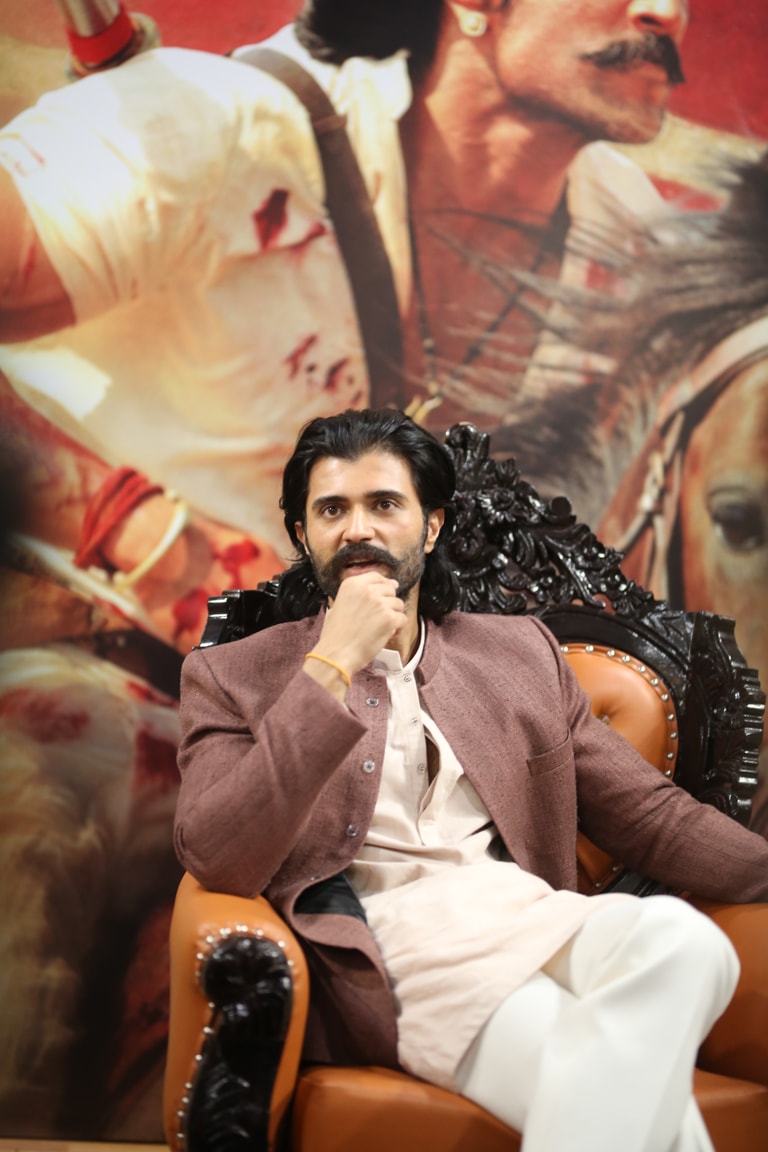
‘Ranabaali’ Will Offer a Great Cinematic Experience and an Emotional High; Audiences Will Discuss Our Culture and History After Watching the Film – Vijay Deverakonda
‘Ranabaali’ is a big-budget pan-India film starring Vijay Deverakonda in the lead role, with Rashmika Mandanna as the female lead. Directed by Rahul Sankrityan, the film is being produced by Naveen Yerneni and Y. Ravi Shankar under the banner of Mythri Movie Makers and presented by T-Series. The film is gearing up for a grand worldwide theatrical release on October 16, coinciding with the Vijayadashami festival. In a recent interview, Vijay Deverakonda shared several highlights about the film.
– After ‘Pelli Choopulu’, this is a film that I am comfortably promoting, checking the final copy two or three times before bringing it to audiences. There is a lot of CGI work involved in the film, especially in its backdrop. We understood the importance of CGI during pre-production itself, and we delivered all the CGI scenes by February. We expect to receive the censor certificate on Monday. Whatever certificate the film receives, it is fine. We make different films for different reasons, and we made this film with a specific purpose. Recently, while speaking to a senior journalist in Chennai, he told me about the famine that occurred in Bengal. Many people died of hunger. He said that Americans learned about India’s condition through some American newspapers and came to know about the terrible circumstances created by the British. This reportedly inspired them to begin fighting for their own country’s independence. The journalist told me that the suffering of our people became an inspiration for America’s struggle for independence.
– When we learn about the injustices our people faced throughout history, we are shocked and wonder whether such terrible things really happened. Some people did not consider us worthy of even the slightest respect. They looked at us as no different from trees and bushes. If we want to think about our country’s future, it is important to understand our history. If we make the right attempt with this film, it could pave the way for more films of this kind. There may be efforts to uncover the hidden chapters of our history through cinema. Otherwise, nobody may come forward to tell such stories. That is why we made this film with a sense of responsibility and took great care in its making.
– The British did not come here intending to settle down permanently. They came for trade. Even today, some Indians believe that the British built Indian Railways for our benefit. They did not build railway lines to make travel convenient for us. They built railway connections to major ports to transport the wealth they were extracting from our country, including grain, cotton and gold. Between 1876 and 1878, a famine in the Madras Presidency claimed the lives of 8 million people. The actual number may have been even higher. The historical accounts and technologies developed by the West do not always tell us the full truth; they often present history from their own perspective. In the Travancore region alone, 6.5 million people reportedly died due to famine. If such a terrible famine occurred in the Madras Presidency alone, there were many other famine episodes in places such as Bihar and Bengal that remain less known to us. A famine caused by a lack of rainfall is one thing. In earlier times, local rulers and community elders would reduce the tax burden on farmers and the public during such crises. But after the British arrived, they began collecting double taxes in famine-stricken regions. Those who could not pay were taken to work on major projects and railway lines under extremely harsh conditions. They were given only a meagre quantity of grain in return. Those who could not work had no option but to starve. Learning about these atrocities in history is deeply distressing.
– No matter what circumstances we faced, our culture and beliefs kept us united as a society and helped protect us. During famines, people worshipped village deities and held jatara festivals, believing that the following year would be better. At that time, people did not necessarily have the idea of fighting for the country’s independence. Instead, they resisted by saying that foreigners had come into their villages, were exercising control over them and were hurting their self-respect. Our history has many great warriors who stood up for their people. Many of these warriors died in their thirties. They are the inspiration behind ‘Ranabaali’. Their stories reached people through folk songs that kept their memories alive, and later, some Indian writers documented them in books. Through ‘Ranabaali’, we are bringing to the big screen, for audiences across the world, the greatness of these warriors, the atrocities our ancestors endured, the mistakes we made as a society, and how the British managed to take control of this vast country.
– The British entered India through trading companies and began creating divisions among our rulers by speaking ill of one king to another and provoking conflicts. They gradually took control of different kingdoms by exploiting our disunity. The greed, mistakes and conspiracies of some of our own people also played a role. In history lessons, we are often made to memorise the dates and years of battles such as the Battle of Plassey and the Mysore Wars, but we are not taught enough about the suffering ordinary people endured during those times. We must understand what happened to us in the past so that we can prevent similar things from happening in the future. History often repeats itself. Even today, several countries are fighting one another, and the barriers created by caste, religion and regional identity continue to divide us.
– We have complete confidence in the success of ‘Ranabaali’, and that confidence is why we are promoting the film extensively. Director Rahul once sent me a folk video recorded at a jatara in Anantapur. In that video, people sang folk songs celebrating the greatness of several historical warriors. Our film also begins with a similar folk song. We made this film with a single purpose: to present the atmosphere of our villages in those days, our culture, the greatness of our warriors and the events that took place in history. Even our promotions are not aimed at creating hype for the sake of it. We have put together a genuine trailer. Once you enter the theatre and watch the film, you will be transported into its world within five minutes. The film is not simply a series of quickly edited scenes. It follows proper storytelling.
– We designed the action sequences in our film based on the violence that existed during that period. The actual events were even more violent, but we designed the sequences according to what the story required. People did not sit down and discuss their differences the way we do today. Conflicts often became matters of life and death. This is not a story that can be told softly, nor is it a world that can be portrayed gently. We have not included action scenes merely for the sake of action. People in those days were much rougher, but we have not shown the full extent of the violence that existed at the time. The film’s runtime is 2 hours and 50 minutes. My appearance and way of speaking as Ranabaali will feel natural, as Rahul designed the character that way. He has made the film with a mass-oriented and realistic approach. I studied in Puttaparthi for ten years, so I was somewhat familiar with the Rayalaseema dialect. However, I trained extensively to get it right for this film. The Telangana and Rayalaseema dialects share some similarities. I practised the dialect and dialogues for two to three months.
– Director Rahul suggested Rashmika for the role of Jayamma, and I also felt she would be the right choice. Her name had come up for the female lead in some of my earlier films, but I felt she was not the right fit for those projects. I wanted the film we did together to be something special. ‘Ranabaali’ has a strong dramatic and emotional relationship between our characters. Working together has added greater emotional depth to these roles because our real-life connection also influences how the characters come across. I believe audiences will feel that when they watch the film.
– I worked hard to learn the Rayalaseema dialect and train in horse riding for this film. Rahul conducted extensive research to decide how my character should speak. We often see hero characters who speak very little, but Ranabaali is not like that. He speaks forcefully, in keeping with the way warriors of that era would have spoken. Rahul was very particular about this aspect. Whenever I act in a film, I approach the character as though it is a part of my real life. Every film I work on affects me personally and changes me in some way. ‘Ranabaali’ has also had a personal impact on me.
– ‘Ranabaali’ will offer audiences a great cinematic experience and an emotional high. It will keep them engaged from beginning to end. After watching the film, people will walk out of theatres discussing our history and culture. Director Rahul is the heart and soul of this film. The producers and I have contributed our inputs, but Rahul has taken complete responsibility for bringing everything together. He has ensured perfect casting for every character. Arnold Vosloo has also delivered a good. During my college days, I felt disappointed when I could not watch certain films because of increased ticket prices. As a hero, I do not like ticket price hikes for my films. There will be no ticket price hikes for ‘Ranabaali’ or any of my upcoming films. Unless I work with Rajamouli Garu, we will not increase ticket prices for my films. Rahul Sankrityan is making a film with me in the Rayalaseema dialect, while Ravi Kiran Kola is making a film set in the Godavari districts. These directors want to present me as a heroic character while retaining the authenticity of their respective regional dialects. If I get an opportunity to act in a devotional film or a biopic, I will definitely consider it.