





The Captain’s Comeback: How Two Directors Conquered the Box Office
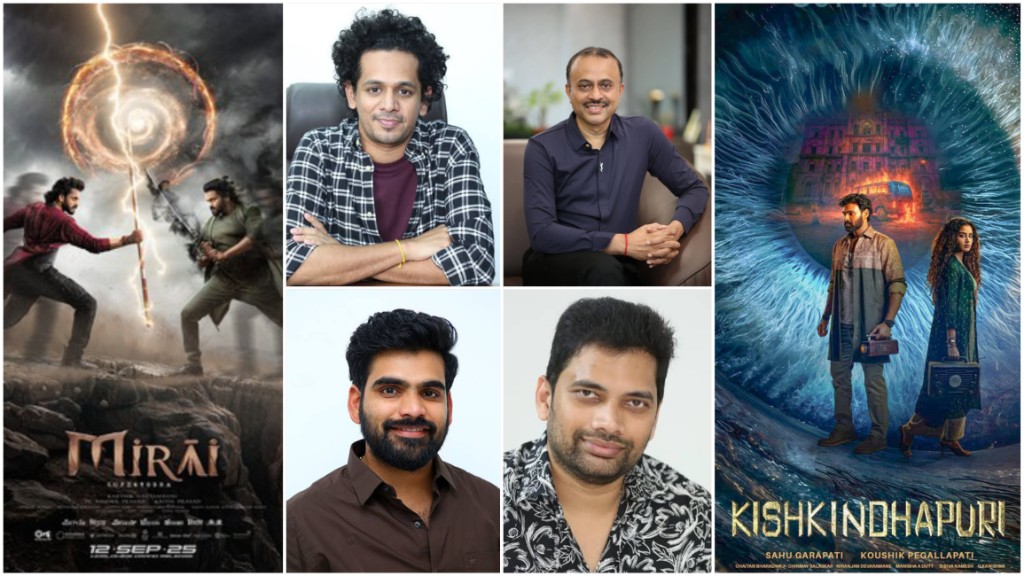
In filmmaking, the director is the captain of the ship, the one who navigates creative storms to bring a story to shore. This is the story of two such captains, Karthik Ghattamaneni and Koushik Pegallapati, who, after facing rough seas with their initial ventures, made a triumphant return to conquer the box office. Their recent blockbusters, Mirai and Kishkindhapuri, are not just hits; they are roaring successes that tell a powerful story of learning, adaptation, and redemption. And behind these resilient directors were two visionary producers, TG Viswa Prasad and Sahu Garapati, who, having walked a similar path of perseverance, placed their trust in these captains to deliver victory.
The Directors’ Roaring Comeback from the Brink
At the heart of this turnaround are two filmmakers who transformed past failures into a winning formula.
Karthik Ghattamaneni: From Flops to a Pan-India spectacle
With Mirai, Karthik Ghattamaneni has delivered a cinematic spectacle, grossing over ₹90 crores worldwide and cementing his place as a formidable director. This victory is especially sweet considering his past struggles. A celebrated cinematographer, his directorial debut failed, and his second film, Eagle, also couldn’t achieve commercial success. he had technical genius without a resonant market hook. His work on Karthikeya 2 provided the crucial data: audiences are no longer interested in generic spectacle, they demand spectacle rooted in cultural IP. The turning point was his work as DOP and editor on the blockbuster Karthikeya 2. There, he unlocked the code to pan-India success. As a cinematographer, he understood how to translate budget into on-screen grandeur better than anyone, making him the ideal vessel for this new epic-craving market.A high-concept story deeply rooted in Indian culture, executed with world-class visuals. Mirai is the spectacular result of that lesson—a testament to a director who learned, evolved, and came back stronger.
Koushik Pegallapati: From a Debut Disaster to a decent hit
Koushik Pegallapati scripted a phenomenal comeback with Kishkindhapuri, a film that became a super hit which made on a modest budget. This success stands in stark contrast to his debut, Chaavu Kaburu Challaga, which was a box-office disaster. Instead of being discouraged, Koushik strategically analyzed the market. He realized that for a low-budget film to truly connect, a smartly written horror-thriller with comedy in the vein of Stree was the perfect vehicle. By focusing on sharp technicalities and clever writing, he proved that a director’s sharp strategy, not just a big budget, is what creates a blockbuster. Koushik’s success with Kishkindhapuri is a cinematic application of a lesson learned from streaming. Platforms like Netflix and Prime Video have conditioned audiences to value a high-concept plot over A-list stars. Koushik applied this “OTT-to-Cinema” model, recognizing that a clever, self-contained horror-thriller with comedy concept could generate immense word-of-mouth, mirroring how a hit streaming series goes viral.
The Producers’ Gambit: Backing the Resurgent Captains
Behind every great director’s comeback is a producer who is willing to bet on their renewed vision.
TG Viswa Prasad of People Media Factory and Sahu Garapati of Shine Screens were the perfect backers. Having faced their own share of failures among their vast filmographies, they understood resilience. They didn’t see directors with a flop history; they saw filmmakers who had learned invaluable lessons.
TG Viswa Prasad saw the massive potential of a pan-India mythological thriller and trusted Karthik Ghattamaneni’s newfound expertise to execute it on a grand scale.
Sahu Garapati recognized the cleverness of Koushik Pegallapati’s genre strategy and backed his vision to create a high-quality entertainer on an efficient budget.
This wasn’t just a financial investment; it was an alignment of philosophies. Both the producers and directors had abandoned standard commercial formats and comfort zones. They came together, united by a belief in high-concept, content-driven cinema. The spectacular collections of Mirai and Kishkindhapuri are the explosive result of this shared conviction.
The Final Word: A New Blueprint for Success
This story of a “double comeback” provides a new blueprint for success in Tollywood. It proves that a director’s past failure is not a disqualification but a training ground. When a director, armed with lessons from the past, joins forces with a producer who is wise enough to bet on that growth, the result is more than just a hit. It is a powerful statement that in the world of cinema, the most spectacular comebacks are born from courage and collaboration.
The Future Trajectory: A Bifurcated Industry
This new doctrine signals a fundamental and irreversible shift, leading to a bifurcated industry model.
The Event Epic: At one end are the high-budget, culturally rooted, IP-driven event films like Mirai. These are massive gambles designed to launch cinematic universes and long-term revenue streams.
The High-Concept Profit Engine: At the other end are the lean, smart, genre-specific films like Kishkindhapuri. These are economically efficient, de-risked through pre-sales, and designed for high profitability and potential licensing.
The middle-ground—the vaguely defined, star-driven commercial film without a strong concept—faces the highest probability of extinction. This doctrine also de-risks the star system; it proves that the concept, the genre, and the execution are now more bankable than an A-list actor’s fee alone.
The Final Word: A New Epoch
This isn’t just a trend; it’s a new epoch for Indian cinema. It’s a strategic, data-informed, and economically resilient model where success is no longer a gamble but the calculated outcome of aligning a director’s renewed vision, a producer’s architectural strategy, and a deep, analytical understanding of what the modern audience truly craves. This is the new formula.